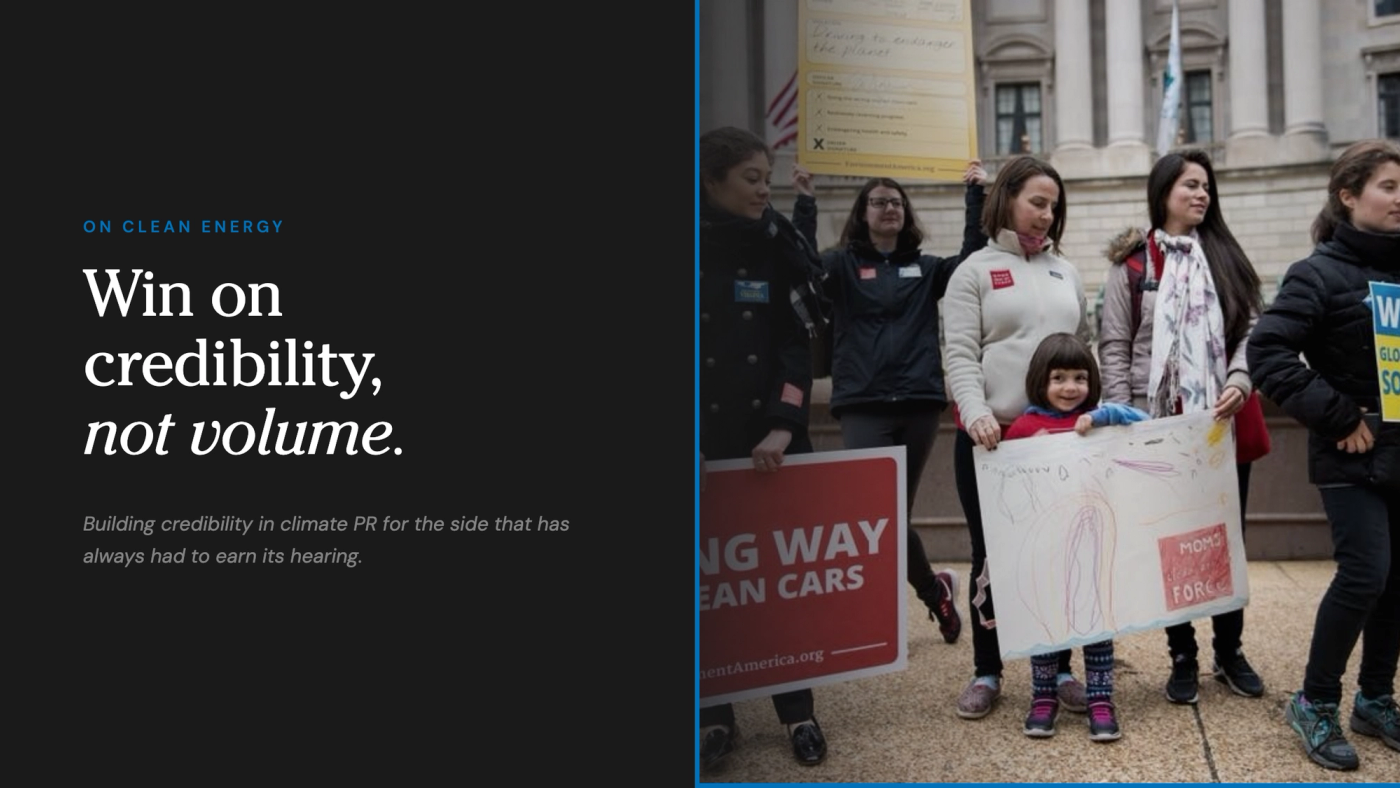




When researchers at Brown University mapped public relations work in climate politics from 1988 to 2020, they did not find a fair fight. The fossil fuel and utility sectors hired the most firms. The environmental movement hired the fewest. That imbalance is the starting condition for clean energy communications: the side making the long-term case has usually been the quieter voice in the room.
The ground has shifted underneath that fight. Renewable sources now supply close to a quarter of US electricity, and the largest clean energy manufacturing investments of recent years have landed in places few people associate with climate politics. The reality has moved faster than the public conversation about it. Building credibility in climate PR now depends less on winning an argument about the planet and more on making the concrete, verifiable stakes of clean energy legible to people who never set out to be climate voters. I have spent more than two decades doing that work, for the organizations on the smaller-budget side of that gap.
What Makes Clean Energy Communications Hard
Clean energy communications is the work of building public understanding and support for renewable energy, climate technology, and the policies behind them. What makes it hard is not the science. It is that the subject is abstract, the audience is divided, and the field inherits the credibility cost of every inflated green claim ever made.
Energy is something most people feel only as a monthly bill and a light that turns on. Translate a wind project into "clean megawatts" and it stays abstract. The polarization compounds the problem: much of the public has learned to hear climate language as a political signal rather than an economic one. And because a decade of greenwashing has trained the public to distrust green claims, even an honest one now arrives under suspicion. Those three pressures, abstraction, division, and inherited distrust, are what every credible clean energy message has to overcome.
How Clean Energy Communications Earns Credibility
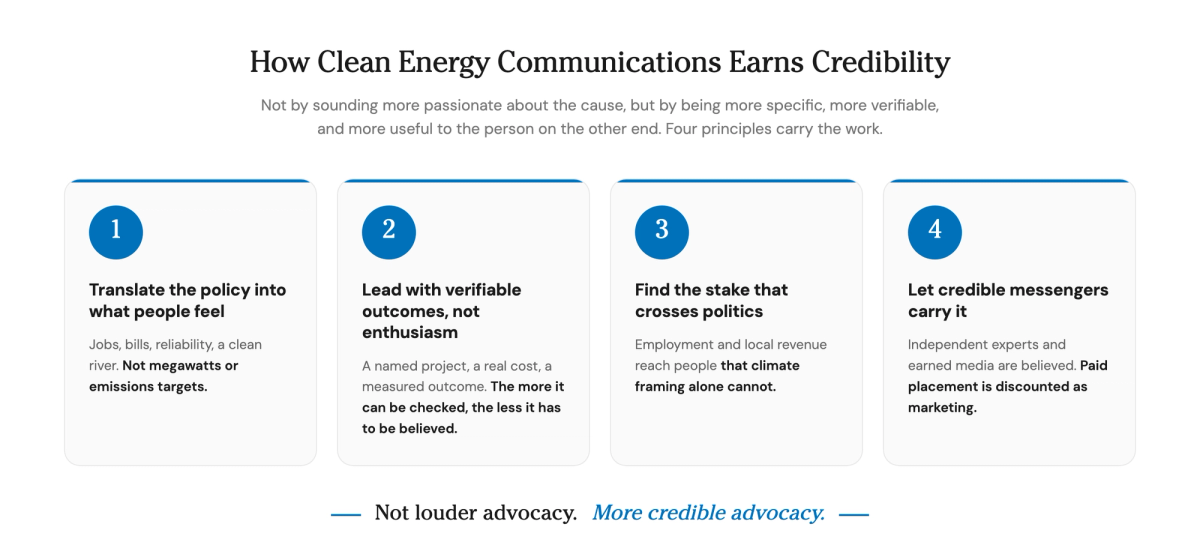
Credibility in this field is not won by sounding more passionate about the cause. It is won by being more specific, more verifiable, and more useful to the person on the other end. Four principles carry the work.
1. Translate the policy into what people feel
People do not experience energy as emissions targets. They experience it as a utility bill, a local job, a reliable grid, a clean river. Credible clean energy communications begins by translating policy into those terms and stays there.
Since 2008, our work with E2, Environmental Entrepreneurs, has run on the economic case: the jobs, investment, and competitiveness that clean energy creates. We built a business-forward narrative around the voices of CEOs and investors and anchored E2's clean energy jobs reports in the news cycle, which moved the conversation from environmental cost to economic strategy. E2's executive director, Bob Keefe, makes that case at book length in Climatenomics, which we supported: climate change as a force already reshaping Washington and Wall Street, not a distant environmental worry. "Good for the climate" is a value. "Good for your county's tax base and the jobs down the road" is a stake. The second one reaches people the first one never will.
2. Lead with verifiable outcomes, not enthusiasm
Clean energy attracts believers, and to a skeptical audience, belief reads as bias. The way past it is the same discipline that separates credible environmental communications from greenwashing: specific, documented, checkable claims in place of green adjectives. A named project, a real cost, a measured outcome. The more a clean energy claim can be verified, the less it has to be believed on faith.
3. Find the stake that crosses politics
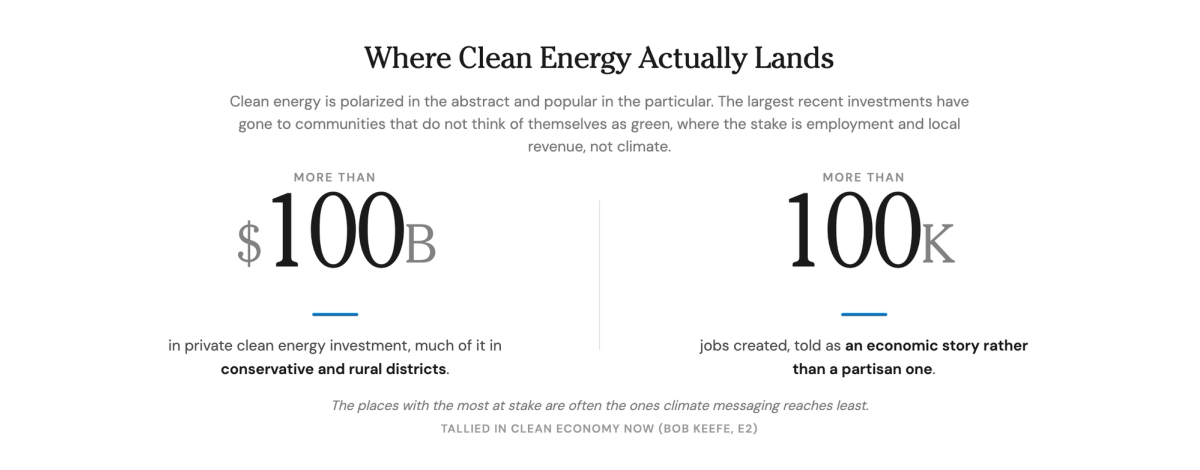
Clean energy is polarized in the abstract and popular in the particular. The largest recent clean energy investments have landed in rural communities, many of them politically conservative, for reasons of land, cost, and existing infrastructure, where the stake is employment and local revenue rather than climate. That is the case Keefe lays out in Clean Economy Now, a second E2 book we supported, which tallies more than $100 billion in private clean energy investment and more than 100,000 jobs, much of it landing in conservative districts and told as an economic story rather than a partisan one. The message that endures names that concrete stake and lets it cross the lines that climate framing cannot. This is not a matter of hiding the climate case. It is a matter of leading with the part of it that every audience can act on.
4. Let credible institutions and earned media carry it
Public trust in clean energy follows the messenger. A claim carried by an independent expert through an earned news story is believed. The same claim in a paid placement is discounted as marketing. For nearly two decades our work with the Union of Concerned Scientists has put that to work, most visibly in "Danger Season," a frame we defined to turn abstract climate science into the immediate, lived risk people were already feeling: extreme heat, wildfire smoke, storms, strain on the grid. The credibility lived in the scientists and the coverage, not in a slogan. That is the difference between policy and institutional communications built to earn trust and promotion built to rent attention.
Put the four side by side and the pattern is clear.
| The instinct | Loses credibility | Earns credibility |
|---|---|---|
| The frame | Megawatts, emissions targets, "the transition" | Jobs, bills, reliability, local impact |
| The tone | Enthusiasm and green virtue | Verifiable, specific, checkable claims |
| The reach | Speaking to people already convinced | The concrete stake that crosses politics |
| The messenger | Paid placement | Independent experts and earned media |
The Contest for Public Trust
Clean energy communications is, in the end, a contest for public trust, and that contest has never been evenly matched. The same Brown University study identified Caplan Communications as the single firm behind more than a quarter of all public relations hirings for the environmental movement, with 96 percent of our own work performed for it. That is more than two decades spent on the smaller-budget side of the fight, which is the side that cannot win on volume and has to win on credibility instead.
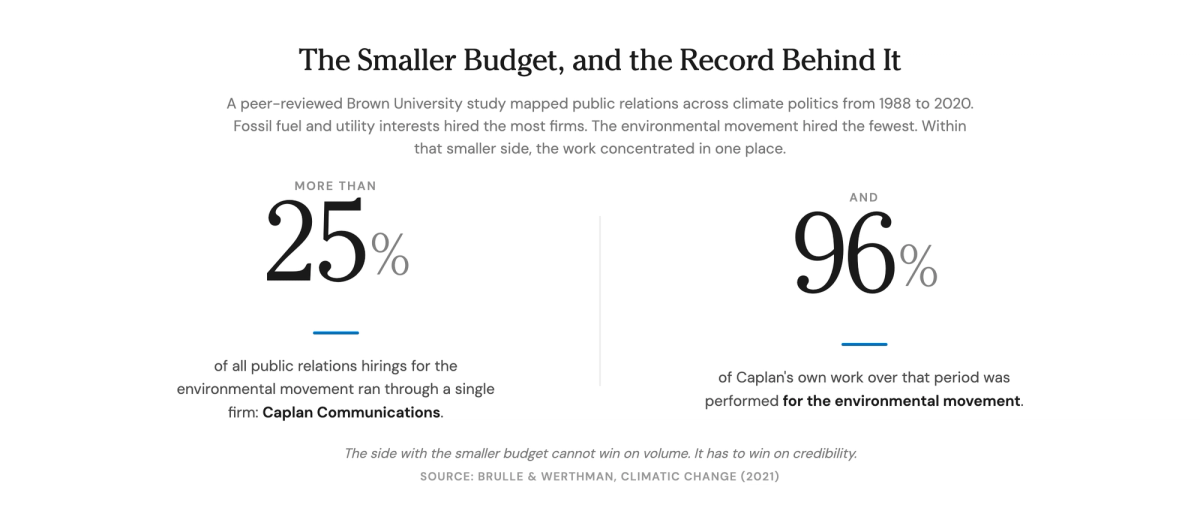
The side with less money to spend cannot afford a single hollow claim. It is a constraint, and it is also the discipline that makes the work hold. When you cannot outspend the other side, you have to out-earn it, in trust.
Clean energy will not be adopted because the public was finally persuaded the planet is at risk. Most people already accept that. It will be adopted because the case was made in terms they could verify and act on. That is the whole of clean energy communications: not louder advocacy, but more credible advocacy, for the side that has always had to earn its hearing.
Frequently Asked Questions
Climate tech PR is communications work for companies building clean energy and climate solutions, from renewable developers to early-stage startups. It carries a specific burden: the technology is often unproven to the public and the field is crowded with inflated claims, so credibility depends on verifiable results rather than vision. The strongest climate tech PR reports what a technology has done, not only what it promises.
Greenwashing manages appearance. Clean energy communications, done credibly, reports verifiable conduct: real projects, real costs, real outcomes. The difference is whether the claim can be checked. A credible clean energy story is built to survive scrutiny. Greenwashing is built to avoid it.
By being specific and letting others vouch for them. Concrete claims about jobs, costs, and outcomes earn more trust than enthusiasm, and independent experts and earned coverage carry more weight than paid promotion. Trust in clean energy is built the way trust is built anywhere: with evidence, over time, through messengers the public already believes.

Aric Caplan
Founder, Caplan Communications
Aric Caplan has advised national nonprofits, coalitions, and public agencies on high-stakes communications for more than two decades. He founded Caplan Communications in 2004, building a practice grounded in integrating earned media, message strategy, and rapid response into policy and regulatory processes. His work spans climate action, environmental protection, civil rights, and public health.