



People often mistake visibility for success in communications. They see the headline, the interview, the op-ed, the viral post, or the policy outcome and assume that is the work. It isn't. The real job is helping people understand an issue before others define it for them.
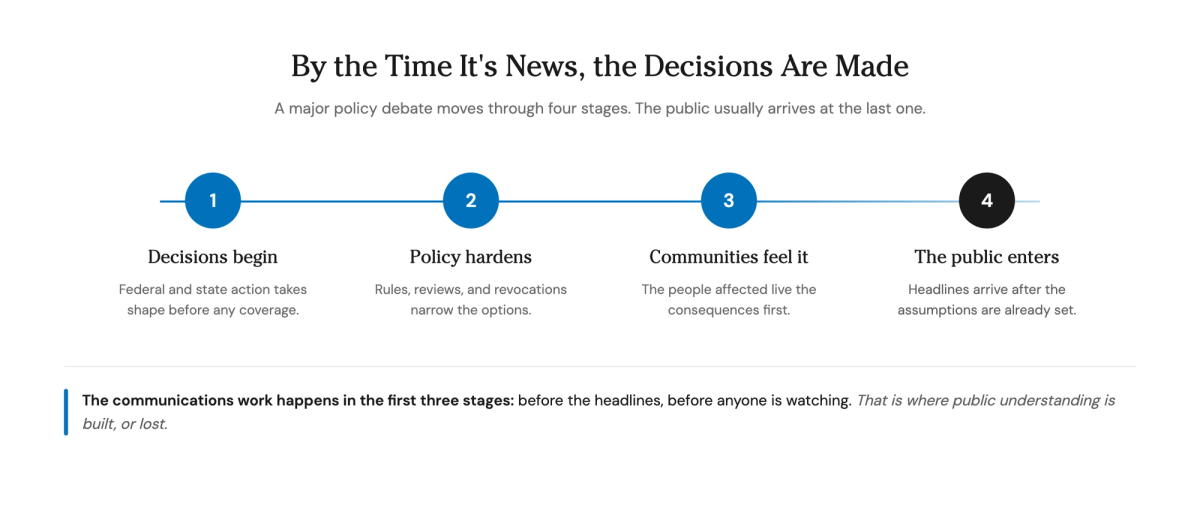
Major public-policy debates begin long before most people know they exist. By the time an issue reaches national headlines, decisions are being made, policies are taking shape, and affected communities are already feeling the consequences. The public usually enters the conversation much later, after assumptions and competing narratives have begun filling the gaps left by incomplete information.
Over the last nine months, I have witnessed that process firsthand while supporting UNITED SIKHS as the organization responded to federal and state actions affecting commercial driver's licenses held by legally authorized immigrant truck drivers. Federal transportation officials pressured states to review, cancel, revoke, or stop issuing licenses they considered noncompliant. Drivers who had worked here legally for years suddenly faced uncertainty about their ability to continue earning a living. Yet for many Americans, the issue remained largely invisible.
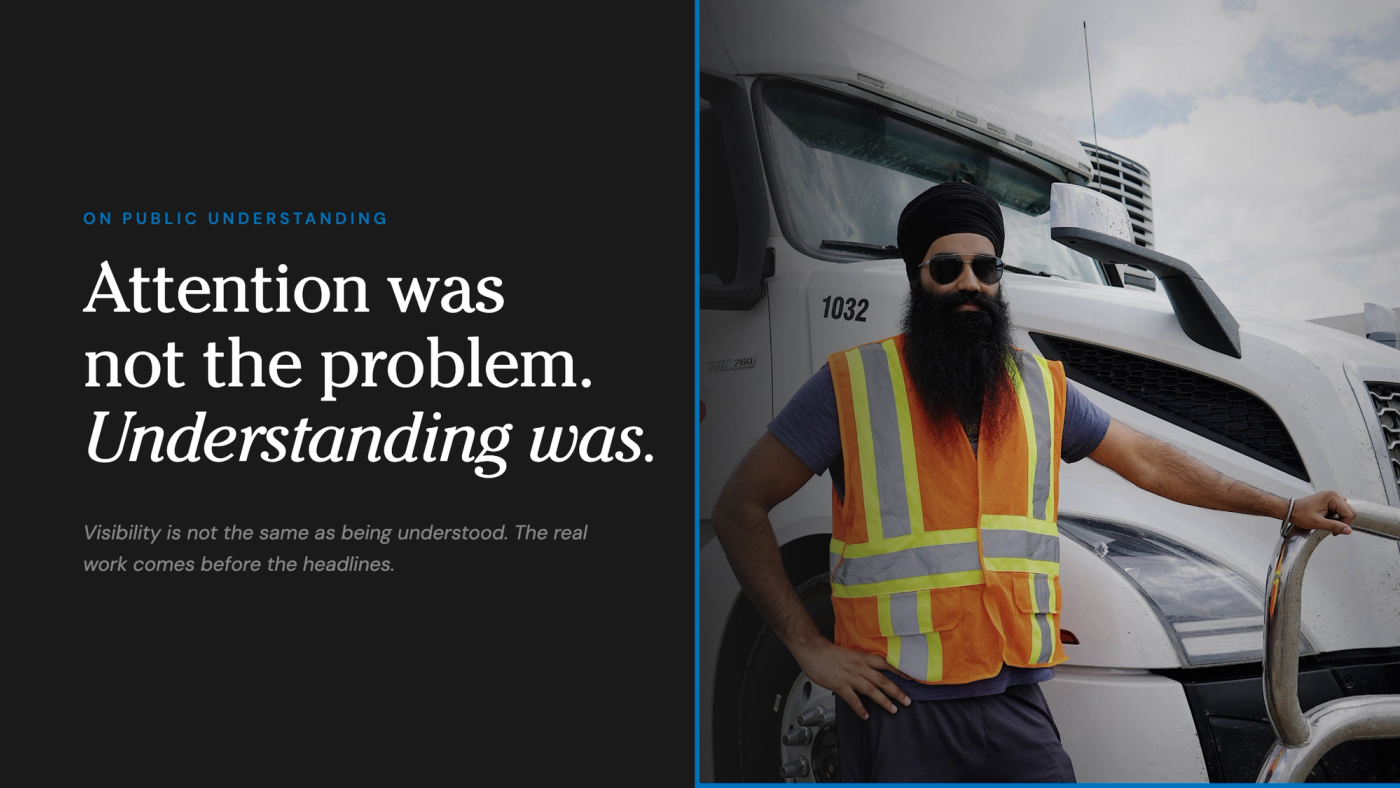
Attention was not the problem. Understanding was.
The whole difference fits in a single contrast:
| Attention | Understanding | |
|---|---|---|
| What it is | Visibility: the headline, the interview, the viral post | Whether people grasp an issue well enough to think about it clearly |
| How it comes | Won quickly | Built slowly, before the headlines |
| What it runs on | Assumptions and competing narratives | Context, facts, documentation, credible sources |
| What it leaves behind | A debate driven by what people already assume | A debate informed by what is actually true |
When a License Is a Family's Livelihood
A commercial driver's license is not simply a credential. For many drivers, it is the foundation of a family's financial stability. It helps keep a roof overhead, vehicles on the road, businesses operating, and household budgets intact. When that stability is suddenly placed at risk, the consequences are felt far beyond the driver's seat.
The licenses at issue were known as non-domiciled commercial driver's licenses, a category used by certain legally authorized immigrant truck drivers. Outside the trucking industry, few people had heard the term. Many reporters had never covered the subject. Most policymakers were unfamiliar with the practical realities facing affected drivers and their families. Reporters, policymakers, advocates, and affected communities were all trying to make sense of a complex issue involving transportation policy, work authorization, state licensing systems, due process, and economic consequences.
Policy Communications Before the Headlines
Throughout that process, UNITED SIKHS served as a bridge between affected drivers, attorneys, policymakers, journalists, and communities seeking answers. Before meaningful reporting could occur, basic questions needed answers. How many drivers were affected? Which states were taking action? What options existed for drivers whose licenses were suspended, canceled, or not renewed? Those questions sound simple. They were not.
The answers often varied from state to state. Policies evolved, court challenges emerged, and new guidance was issued. Some viewed the issue exclusively through the lens of immigration politics. Others viewed it solely through the lens of civil rights. Yet the reality was more complex than either narrative. Social media amplified certainty long before it amplified facts or understanding.
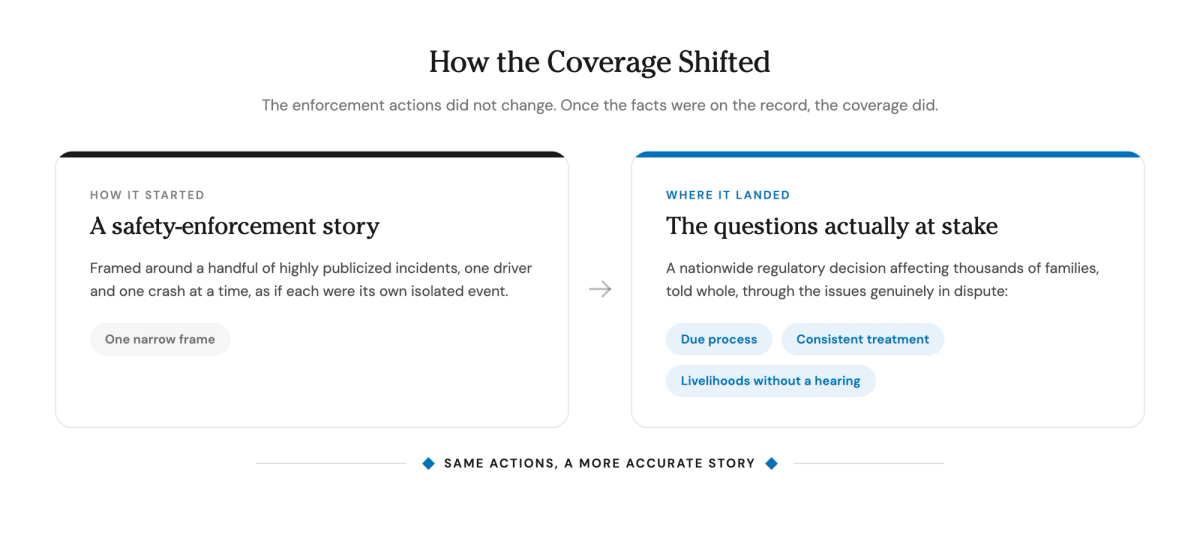
As the debate unfolded, public perceptions were often shaped by a small number of highly publicized incidents involving commercial drivers. But the broader policy questions extended well beyond any single crash, requiring policymakers, journalists, and the public to distinguish between individual events and nationwide regulatory decisions affecting thousands of drivers and their families.
That work had a concrete shape. Working with UNITED SIKHS, we built a platform called Freedom Drivers to document, in real time, what the enforcement actions were doing to drivers and their families, first in California and then well beyond it. We worked to connect individual cases to the larger pattern, so that each license loss was understood as part of a policy failure rather than an isolated incident, and we kept the communications aligned with what was actually on the record in the active legal filings, because a reporter can only report what can be shown. Over those months, the coverage shifted from a story about safety enforcement to the questions that were genuinely at stake: due process, consistent treatment, and whether legally authorized workers were losing their livelihoods without a hearing. None of that came from a louder message. It came from the slow, largely invisible work of policy communications, the part that happens before the headlines and rarely shows up in them.
Why Context Is the Rarest Thing in Public Debate
Public debates are often shaped by people who are still forming their views: the transportation reporter trying to understand a developing story, the state legislator hearing from constituents, the trucking-company owner trying to understand the impact on employees, and the citizen who believes both public safety and due process matter and need not be in conflict. Reaching them requires something increasingly rare in modern public discourse: context.
Context connects policy decisions to real-world impacts. It helps explain why a regulatory action can become a family crisis, how federal pressure can influence state decisions, and why communities may experience the same policy differently depending on geography, implementation, and timing.
Context also helps people recognize unintended consequences. One of the recurring concerns raised by UNITED SIKHS involved workers who believed they had complied with existing requirements, only to find themselves caught between changing policies, administrative decisions, and conflicting interpretations of eligibility. Whatever one's position on the underlying policy debate, those stories raised legitimate questions about fairness, consistency, and due process.
Public Understanding Rarely Emerges on Its Own
Public understanding rarely emerges on its own. Someone must do the work of providing context, answering questions, addressing misconceptions, and ensuring that those most affected are heard. My own background in journalism reinforced another important lesson. Reporters are not looking for advocacy talking points. They are looking for facts, documentation, credible sources, and clear explanations. The more complicated the issue, the more important those fundamentals become.
For advocacy organizations, journalists, policymakers, and communicators alike, that work is rarely glamorous. It happens before the headlines. Yet it is often the difference between a public debate driven by assumptions and one informed by facts.
The most important communications challenge is not persuading people what to think. It is helping enough people understand an issue well enough to think about it at all.
Frequently Asked Questions
Attention is visibility: a headline, an interview, a viral post, a policy outcome. Understanding is whether people grasp an issue well enough to think about it clearly before others define it for them. Attention can be won quickly. Understanding has to be built, by answering basic questions, providing context, and correcting misconceptions while the facts are still being established.
Context is what connects a policy decision to its real-world impact. It explains why a regulatory action can become a family crisis, how federal pressure can shape state decisions, and why two communities can experience the same policy very differently. Without context, public debate runs on assumptions and competing narratives. With it, people can tell an individual incident apart from a nationwide decision affecting thousands of families.
You do the unglamorous work before the headlines. In the commercial driver's license fight, that meant documenting in real time what was happening to drivers, connecting individual cases to the larger pattern instead of treating each as an isolated incident, keeping the message aligned with the legal record, and giving reporters the facts and context to cover a complicated policy accurately. That is what policy communications is for: not more attention, but a public debate informed by what is actually true.
A non-domiciled commercial driver's license is a CDL category used by certain legally authorized immigrant truck drivers. Outside the trucking industry, the term is unfamiliar to most reporters, policymakers, and members of the public, which is part of why recent federal and state actions affecting these licenses were so difficult to report and understand accurately.

Aric Caplan
Founder, Caplan Communications
Aric Caplan has advised national nonprofits, coalitions, and public agencies on high-stakes communications for more than two decades. He founded Caplan Communications in 2004, building a practice grounded in integrating earned media, message strategy, and rapid response into policy and regulatory processes. His work spans climate action, environmental protection, civil rights, and public health.